
#002 Superplastic, East-West Arbs, and Virtual Influencers
Report #002🐰

Company Overview
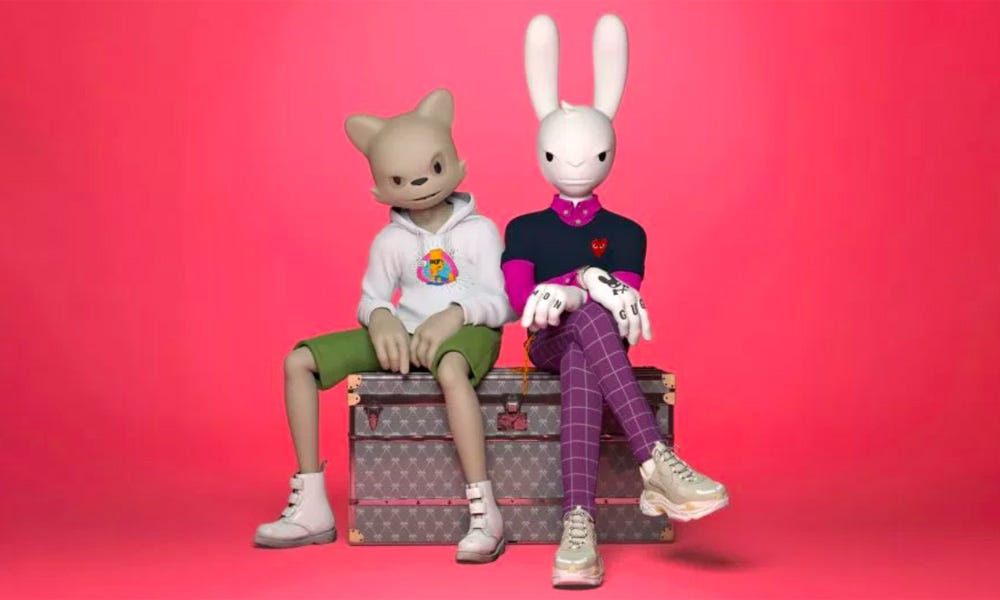
Founded in 2017 by Paul Budnitz, Superplastic is a global entertainment brand that creates and manages animated celebrities with millions (5m to be exact) of dedicated followers on social media. The company's talent roster includes Instagram and TikTok sensations Janky & Guggimon, Dayzee & Staxx, Kranky, ShüDog, and more.
Superplastic has raised $16m from Google Ventures, Craft Ventures, Founders Fund, Index Ventures, Canaan, and a long tail of angel investors like Scott Belsky (Behance), Kevin Weil (Instagram), and Justin Timberlake (NSYNC). According to Budnitz…
“We are building the next Marvel and marketing it like Supreme.”
Business Model
Today, it's an e-commerce business selling limited-edition designer toys, accessories, and apparel. Tomorrow, it's a character-driven shared universe media franchise following the Marvel playbook with graphic novels, shows, movies, and products on the way.
Founder
Budnitz is a prolific creator, artist, entrepreneur, designer, and hacker. After quite a bit of research it's not clear exactly how many companies he's started or products he's shipped, but it's at least a dozen.
Quick bio. He grew up with a Teletype in Berkeley, California with a nuclear physicist father and a social worker mother. His first business was buying fireworks from Chinatown in SF and selling them to friends in Berkley. Fortunately, he avoided a life of crime and went to Yale to study film instead. While in college, he started M.O.B., his second east-west arbitrage business selling vintage collectibles (think Levis and Air Jordans) to buyers in Japan. All proceeds went to finishing 93 Million Miles From the Sun, his first film, and the first film edited on a home computer.
His next company, MiniDisco, was yet another east-west arbitrage. This time, Budnitz brought Sony MiniDisc players from Japan to the US. He hacked them to double as a recording device and coded up a website, one of the first e-commerce sites on the web. With Apple's iPod around the corner, Budnitz sold MiniDisco and started a new company. Yup, you guessed it, east-west arbitrage again. This time, Budnitz brought "designer vinyl toys" from Japan to the US. At first, Kidrobot imported to a store on Haight Street in SF, but Budnitz realized he could create the toys himself. Kidrobot went from two employees to 90 and from $300k in sales to more than $15m. Along the way, he wrote two books on designer toys. Oh, and a children's book. Then, in 2012, Budnitz left to start a bicycle company...and a social media company.
Budnitz Bicycles is the "Aston Martin" of bicycles. Ello is the "Facebook killer" private, ad-free social network. While not east-west arbitrages, they follow a few other Budnitz patterns - beautiful, exclusive, and niche. For example, Budnitz has a long waiting list for their few hundred bikes a year for their niche customer base while Ello was invite-only and now caters to a niche creative user base.
According to Budnitz, "When you don’t have very much money, and you don’t know if something’s going to sell, one of the things you can do is, you can just put it up and say, ‘Here’s this thing, but it’s sold out." Budnitz has an uncanny ability to exploit lucrative niches and weaponize virality. One thing most articles on Budnitz miss is his obsession with beauty and how to make something beautiful.
"Business is a vehicle to make something beautiful. And my basic business plan, if you could call it one, is just to make and sell beautiful things and try not to be stupid about it--make sure it's at least possible to make a profit--and just assume that it'll work itself out and make money. This usually works, and occasionally doesn't."
Market and Competition
Where do we start? The collectible toy market? Or, the virtual influencer market? The intersection of the two? The toy market is really big ($91b according to Statista) and the toy collectible market is big ($10b according to NDP Group). These are well-understood markets with lots of data. Instead, I’ll focus on the nascent virtual influencer market where I think Superplastic is really competing.
Unfortunately, Gartner hasn't published their virtual influencer magic quadrant yet and only a few people on the Internet seem to know what's going on with virtual influencers. Perfect! Let's dive in.
A virtual influencer is a digital character created in computer graphics software, then given a personality defined by a first-person view of the world, and made accessible via popular media platforms. They can be humanoid, cartoon, or another design style, so long as the being adopts an unwavering first-person personality.
There are only 100+ virtual influencers, all listed out nice and neat right here just waiting to influence you. Check em out! Their existence is fake, but their influence is real!
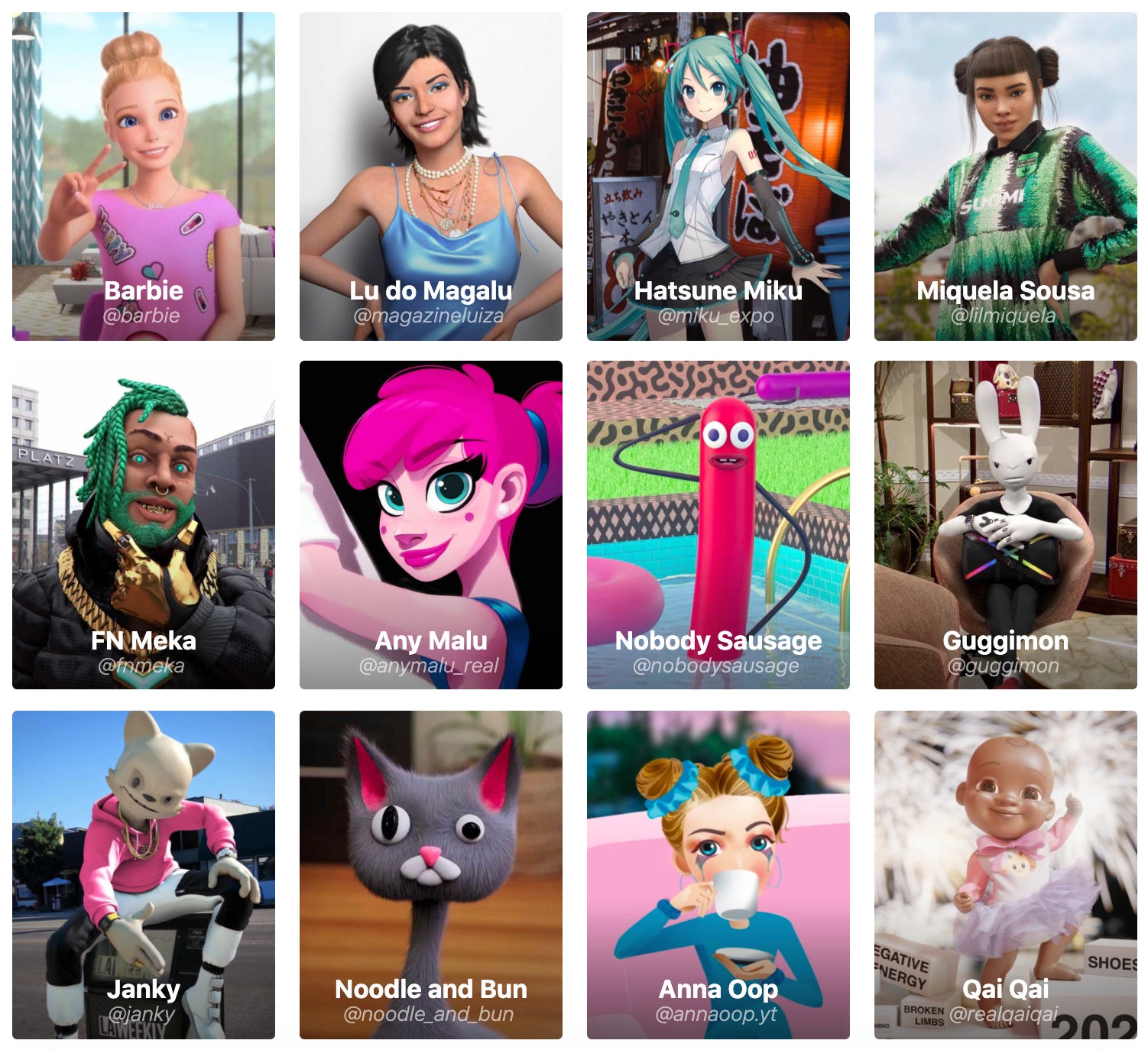
However, like most markets, there's a power-law distribution and the top influencers - Lil Maquela, Barbie (yes, that Barbie), FN Meka, Lu do Magalu, our friends at Superplastic from above, and a few others have the lion's share of followers. What you don't see when following them across TikTok, Instagram, Only Fans, Facebook, or YouTube is the studios behind the influencers.
After spending way too much time seeing what these virtual influencers had for breakfast I've come to a few sweeping generalizations about the teams behind the scenes.
There are professional studios (Superplastic, Brud, Toonstar, Shadows Interactive, Aww Inc) who are selling products or brand mentions, very similar to the conventional influencer model.
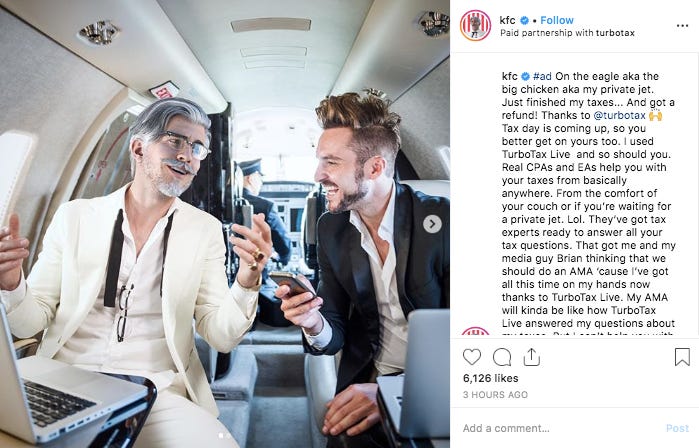
There are established companies (Mattel, KFC, Puma) recycling intellectual property.
There are anonymous hobbyists and artists looking to tell stories and build a community.
There are companies (Virtual Humans, The Diigitals, Fable, Auxuman, Genies), all of which would make fascinating NewCo Reports, looking to innovate and create new business models and relationships.
This is going to be a really really big market. Like "toy market big" big. Here's why. A virtual influencer can do almost everything a real influencer can do. They are faster, cheaper, predictable, can bring higher engagement, and carry less drama or baggage. Basically, no surprise lawsuits or flat earth claims for agents to worry about.
The demand is growing. Digital native GenZs will represent nearly a third of the human population soon and according to Business Insider, influencer marketing spending is on track to surpass $15b soon.
The supply is growing too. Millions of creatives (maybe newly unemployed or with way more free time) around the world are getting familiar with CGI tools, deep (and shallow) fakes, influencers as brands, and how to kickstart memes. Maybe most importantly for new technologies, venture capital is ready to subsidize the hell out of it until it becomes sustainable.
Barriers to Entry, Competitive Advantages, and Moats
Barriers to entry are obstacles to starting the business. Competitive advantage is the leverage a business has on competition. Moats are structural defensive measures to retain market share and increase margins.
Anyone can create and grow social media accounts, yet there are only 100-ish virtual influencers today. That's because there's a real barrier to entry here - the cost of good CGI, motion capture, design, storytelling, marketing, etc. Like most economic barriers to entry, these will get lower over time. As venture capital enters the chat, unreal engine improves, or platform plays like Virtual Humans mature there will be an exponential increase in the number of virtual influencers.
However, competing with Superplastic is more than just creating the influencers, you also need to sort out how to build an e-commerce business, which means suppliers, creatives, supply chains, and the hard part - dealing with customers. Most of all, you need an understanding of how to create a brand and a business model selling scarcity (limited edition toys) AND digital abundance (virtual influencer followers).
We’ll be using Hamilton’s Helmer’s Seven Powers framework to double click on competitive advantages and moats.
Scale Economies. Does the per-unit cost decline as production volume increases?
Not much on the product side as they focus on limited-run and small batches. They do have decent scale economies with their characters as their models and software are already set up. There will be a declining marginal cost per new character created.Network Economies. Does value to each user increase as new users join the network?
There are some light network effects on the products through scarcity, similar to any collectibles company, where each new follower or fan creates more value for the collectible product. On the character side, there's an argument that an additional follower or character adds more value to followers through a shared universe.Counter Positioning. Will the incumbent fail to compete due to anticipated damage to their existing business?
The incumbents here are really animation studios that want to recycle their intellectual property or go to market with new characters. In both cases, they are uniquely qualified to do this well or better than Superplastic. There are no counter positioning powers, which is unusual for a shiny new company. The race is on. Can Superplastic get distribution before the incumbents innovateSwitching Costs. What is the loss expected by a customer from switching to an alternative supplier?
Switching to a new supplier is as easy as scrolling past on Instagram or unfollowing on TikTok. There are non-existent switching costs.Branding. The attribution of higher value to an objectively identical offering.
This is it. This is how Superplastic "wins." This is where they differentiate against Disney, competitive studios, and the sea of hobbyists. Personally, I think they have the management team, design talent, storytelling ability, and craftsmanship to pull this off. Brand power can be fickle and unwind quickly if brand commitments aren’t kept. “Selling out” through too many collaborations with “the man” or off-brand companies could be dangerous.Cornered Resource. Is there preferential access at attractive terms to a coveted asset?
If they have any cornered resources they are temporary. It’s plausible to consider their design skills, creative talent, or any exclusive contracts with collaborators.Process Power. Embedded company activity which enables lower costs and/or superior product.
After branding, this is their second strongest advantage. They have a team that knows how to work together to create shared universes, engineer virality, work with artists, manage global supply chains, and customers. More importantly, they have a revenue engine - e-commerce sales, that other studios don’t have. This revenue engine means more character R&D and the ability to hire more creatives.
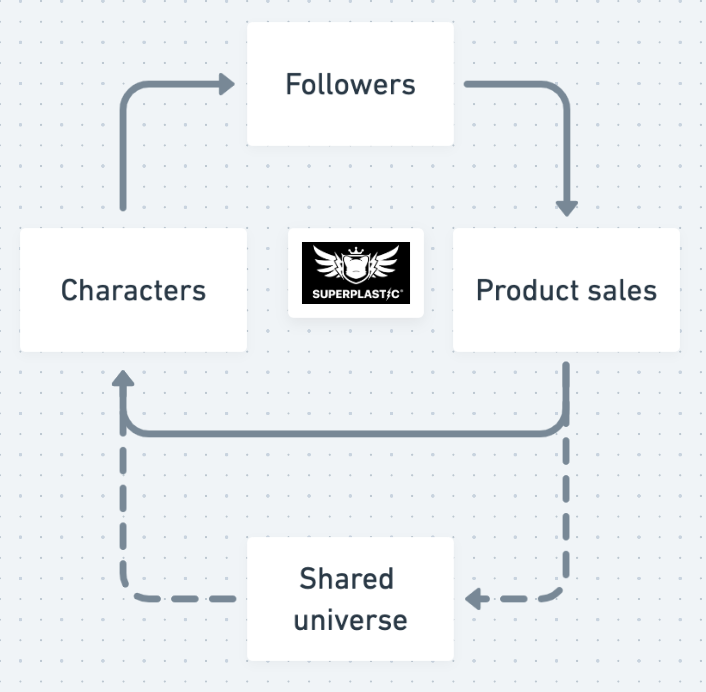
In a market with declining barriers to entry, few economic moats, and no cornered resources Superplastic wins through process power and brand. Fortunately, this is the tried and true Budnitz formula and the Superplastic flywheel has only just begun to turn.
Today, new followers lead to more e-commerce product sales, which leads to more revenue to fund characters. Tomorrow, Superplastic will unveil their sprawling plans for a shared universe. If you remember one thing, remember what Budnitz says about Superplastic…
“We are building the next Marvel and marketing it like Supreme.”
Questions
How and when will Superplastic introduce their plans for a shared universe?
Will we see influential influencers facing unemployment influencing their community to "save our influencers" or "drop the fakes"?
What happens when every company with valuable IP gets FOMO? Will Mario, Harry, Frodo, Luke, and Kirk start to "collab" on Instagram? Does this kickstart the metaverse?
How will regulatory enforcement work with anonymous creators? What happens when virtual influencers break FTC rules?
What happens when AI allows virtual influencers to develop meaningful relationships with individual followers?
Resources and Further Reading
Paul Budnitz
https://www.complex.com/style/2015/11/life-death-and-rebirth-kidrobot
https://www.inc.com/magazine/201106/kidrobot-founder-paul-budnitz.html
https://vtsports.com/paul-budnitz-designs-the-ultimate-town-bike/
Superplastic
Market
https://hypeauditor.com/blog/the-top-instagram-virtual-influencers-in-2020/
https://techcrunch.com/2019/01/14/more-investors-are-betting-on-virtual-influencers-like-lil-miquela
Special thank you to Christoper Travers with Virtual Humans for doing incredible work to aggregate and report on virtual influencers. It’s because of people like you that new industries are formed!